When the weight of the challenges that we face together as Humanity seem too large of a cross to bear, I think it’s therapeutic to find a comfortable chair, clear my mind and meditate on how small and inconsequential our petty human squabbles are in the grand design of the known Universe.
The exact measures of both time and space are virtually impossible for us to wrap our little Homosapien brains around, but let’s give it a try.
Our best guess is that the known universe is say… 14 BILLION years old (give our take a few hundred million years depending on whose data you trust). Contemplating this amount of time is just about unattainable. Our brains anchor on our own lifespan of less then 100 years. We perceive the passing of mere decades as monumental. Remember the 1950’s? Boy, weren’t those just the “good ol’ days” way back 75 years ago. The age of the Universe and the incredible distances between celestial bodies can only begin to be understood by Humans through story telling. So, picture an alien civilization peering down on Earth through very impressive binoculars just at the edge of our Solar System – 200 light years away. Due to the time it would take for the images to reach their vision, they would be entertained by watching our species discover Antarctica, create the first railroads, take the first photograph and sit around Grand Salon’s in goofy powdered wigs listening to the hip new sounds of Beethoven. Crazy, huh?
Another way of trying to wrap your head around time and space is to visualize the chronology of the Universe through the Cosmic Calendar, popularized in the 1970’s by the late, great Carl Sagan. In this visualization, the Big Bang took place at the beginning of January 1 at the stroke of midnight, and the current moment maps to the end of December 31 just before midnight. At this scale, there are 438 years per cosmic second, 1.58 million years per cosmic hour, and 37.8 million years per cosmic day. The Milky Way was formed in March. For Earthlings it was a pretty boring Summer but, in September, the Earth was finally formed when dust and gas gradually clumped together due to gravity. (just in time for the Holidays). Humans finally made in on the scene with 8 minutes left before the ball dropped in Times Square. 8 cosmic minutes in a cosmic year and look at what we’ve done. Contemplate all that we have achieved in just 8 seconds.
How Big Bold and Beautiful are we really in the Great Creator’s grand scheme?
With your arms spread wide… to represent all time on earth, look at one hand with its line of life. The Cambrian begins in the wrists, and the Permian extinction is at the outer end of the palm. All of the Cenozoic is in a fingerprint, and in a single stroke with a medium-grained nail file you could eradicate human history.
John McPhee
In 1977 (48 years ago on a day very close to my 2nd birthday), NASA launched the Voyager 1 space probe in hopes of exploring the moons of Jupiter and Saturn as well as what is known as the “interstellar medium”. Remarkably, Voyager 1 is still out there- traveling at a speed of over 38,000 miles per hour. According to NASA, this hunk of manmade metal is still hurdling toward the edge of infinity and is about 14.5 billion miles from Earth (give or take a few).
Now. Close your eyes and picture the Earth as seen from Voyager 1 as it finally exited our solar system long ago in the year 1990. While we were jamming in our new Honda Accords to “Poison” by Bell Biv Devoe, celebrating the fall of the Berlin Wall and trying to figure out where to get our hands on the elusive Patti the Platypus Beanie Baby, Voyager turned around and took a selfie. At this time and from that vantage point, Earth appeared as a tiny blue speck nearly 4 billion miles away. We know this because the image referred to as “The Pale Blue Dot” was transmitted back for us all to contemplate.

Now. Open your eyes and take a look around with fresh, clear vision. We’re so close to Earth that sometimes we forget the profound beauty it holds. Seen from space, our planet appears remarkably vibrant—a living paradise, delicately suspended in the overwhelming vastness of the cosmos. During Apollo 11’s historic journey to the moon in the turbulent year of 1969, astronauts reported being deeply and profoundly moved to witness Earth rise above the moon’s barren horizon. They call this the “overview effect” – a shift in awareness resulting from viewing our planet from either orbit or the lifeless, blank canvas of the lunar surface.
To date, no other planet has been discovered that harbors life as we know it. Billions of people navigate their lives on this small planet, each filled with joy, happiness, and also profoundly deep suffering. Reports from human space travelers reveal that they often spend their precious free moments gazing in awe at the breathtaking sight of Earth far below. From that distance, it resembles a single, majestic living and breathing organism.
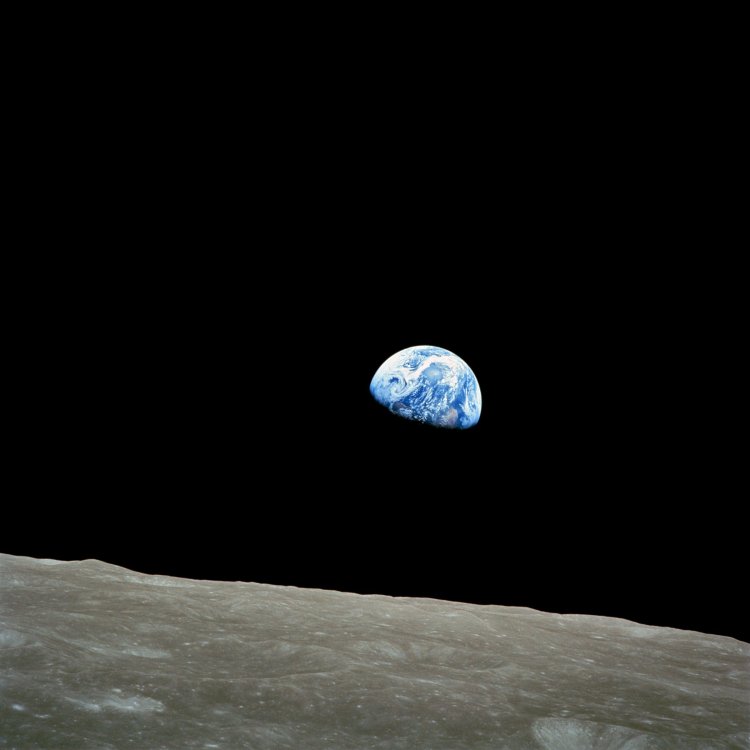
Astronaut Ed Mitchell is quoted as saying, “In outer space you develop an instant global consciousness, a people orientation, an intense dissatisfaction with the state of the world, and a compulsion to do something about it. From out there on the Moon, international politics look so petty. You want to grab a politician by the scruff of the neck and drag him a quarter of a million miles out and say, Look at that….we went to the moon as technicians; we returned as humanitarians.”
So here we are – in the Year 2025 -anxious over the future and ruminating on our collective past. A past that is but a minuscule tick of a second hand on God’s wristwatch. In that time, we have evolved from Apes, domesticated fire, created our first alphabet and organized societies around the stories we tell to disseminate information and help us better understand the World . Stories that seem to give live purpose and answer the big questions like, why we are we all here? and what does it all mean?. Stories about Zeus, Hera and Poseidon. Epic tales like the Trojan War and the adventures of Odysseus. We tell tales of the end of the world and battles between gods and giants – Odin, Thor and the Norse mythologies. Our Egyptian ancestors weaved rich, colorful yarns about the afterlife, the creation of the world, and the roles of their forgotten deities – Ra and Osiris. Isis and Anubis. Their gods once had a hand in maintaining cosmic order but have seemingly vanished from our collective imagination- replaced with new, state-of-the-art Gods. The Celtics gave us tales of magic and the supernatural – heroes slaying Monsters – fairies and leprechauns.
We still tell epic narratives with Buddhist influence and Japanese Shinto beliefs. We recall stories that were adaptions of Greek myths to fit Roman cultural values. Stories of Jupiter, Juno and Neptune. For some of us, the four-armed Vishnu maintains the Universe and ensures balance and harmony. But, for others, the truth is the story of the Son of God, born from a virgin and delivered to Earth to wash away the sins of humanity, his birth date conveniently chosen to replace Pagan festivals celebrating the winter solstice and the returning of the Sun. Some people believe the collection of 600-800 short stories that we entitle ‘The Holy Bible”. Some people believe only Season One – The Old Testament but elect not to believe Season 2 – the New Testament (perhaps readers feel the original authors “jumped the shark” when they elected to turn water into wine or raise old Lazarus from the dead. I’m not sure). Even today, people are fighting over amended versions of that same tale. Waging war and killing in the name of that particular edition that they choose to believe (though somehow Abraham remains a central cast member). Christianity was born of Judaism. Islam recognizes Jesus as a prophet and a messenger of God, but not divine – that role is reserved for Muhammed. It’s more complicated then the re-coupling in Season 4 of Love Island and much harder to understand.
The work of the great American writer and mythologist, Joseph Campbell, has been a huge influence on The Story of Us. His life was devoted to helping humanity understand that all of our stories contain a common narrative that is shared by all world mythologies – from antiquity to present day. Campbell discovered that stories across cultures share a universal structure. He coined this “The Hero’s Journey” and it follows a pattern that echoes in ancient legends, religions and modern stories alike. In stage 1, the hero is compelled to leave the ordinary world. He answers the call to adventure, meets a mentor along the way and at some point, he crosses over the threshold into uncharted territory. There he enters into Stage 2 -The Initiation, wherein he faces trials, temptations, glimpses the abyss, figuratively dies and is reborn, achieves enlightenment and gains the insight he so desperately seeks. With his ego dissolved and a new union with the divine, the hero returns home to us in Stage 3 bearing new found wisdom or power. He is now the master of two worlds with the freedom to live a fulfilled life.
Campbell argued that the human psyche creates these stories that reflect inner growth and spiritual transformation to give us hope and to help us find our bliss -aligning with our deepest desires. These myths aren’t just tall tales – they’re roadmaps for living – past down from generation to generation through sagas, fables and legends. Neither Campbell nor I are making theological claims or choosing sides. We’re just emphasizing symbolic meaning over historical fact (or fiction).
The point here? I don’t care what story you believe so long as it helps you navigate life’s challenges, you don’t harm any one and your version supports you in your unique journey to unlock the mysteries of life. I’m not certain if I truly believe any of them – but I don’t NOT believe. I’m listening and I remain hopeful that, one day soon, we can all agree that no matter in what story you place your faith, you can recognize the common thread that unites us…
We all suffer and, in our own ways, we’re all trying to complete the same puzzle or decode the same message just using alternate versions of the Rosetta Stone… Why are we here? What gives life meaning? Where are we going and what’s the purpose?
So, now that the table is set, I’m excited to begin connecting with all of you. The Story of Us will now begin production and I sincerely hope that the stories we tell, together, will resonate with you and, in small but impactful ways, help to alleviate your suffering and guide you closer to the your truth.
 The Story of Us.
Leave a comment