
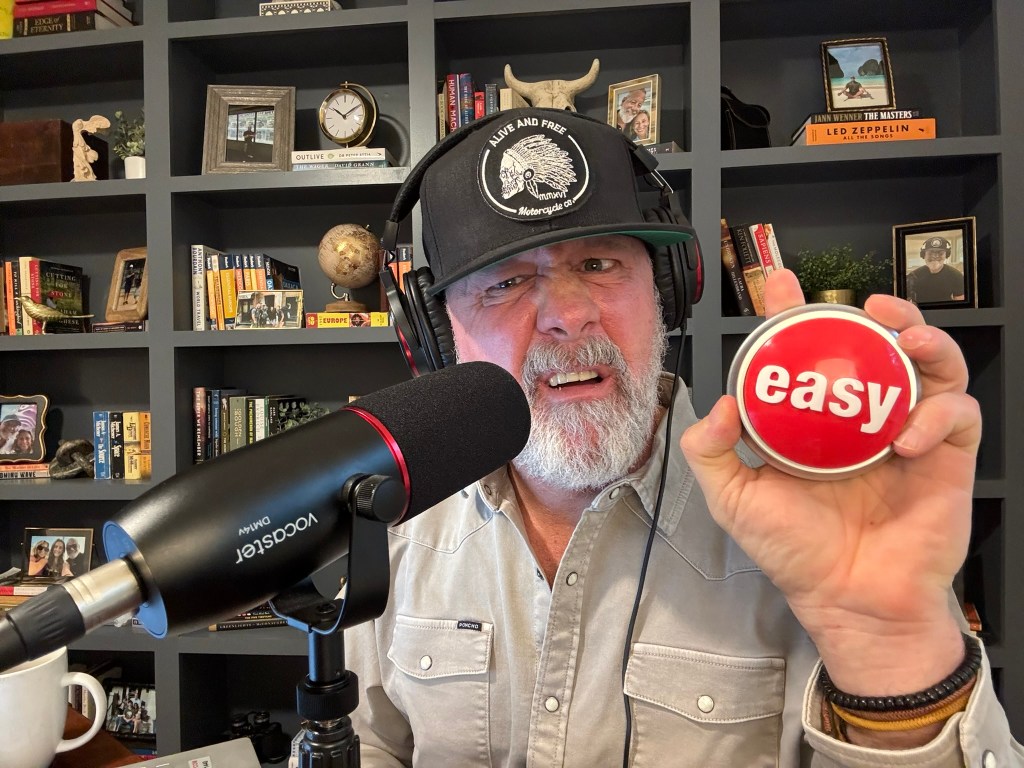
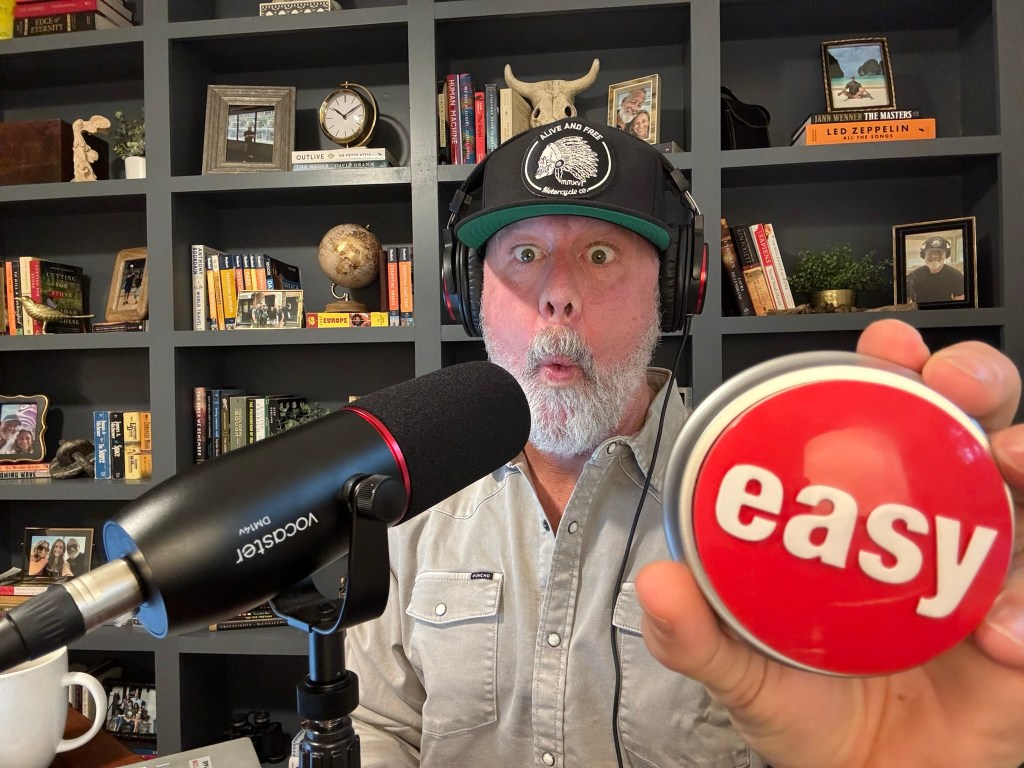

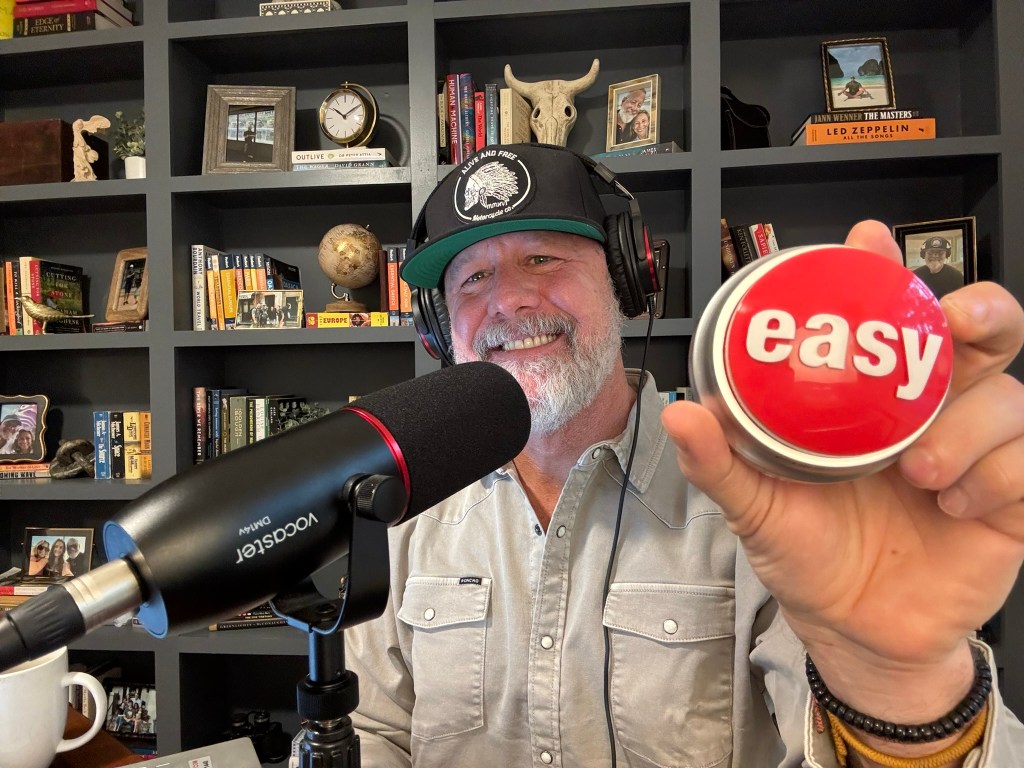
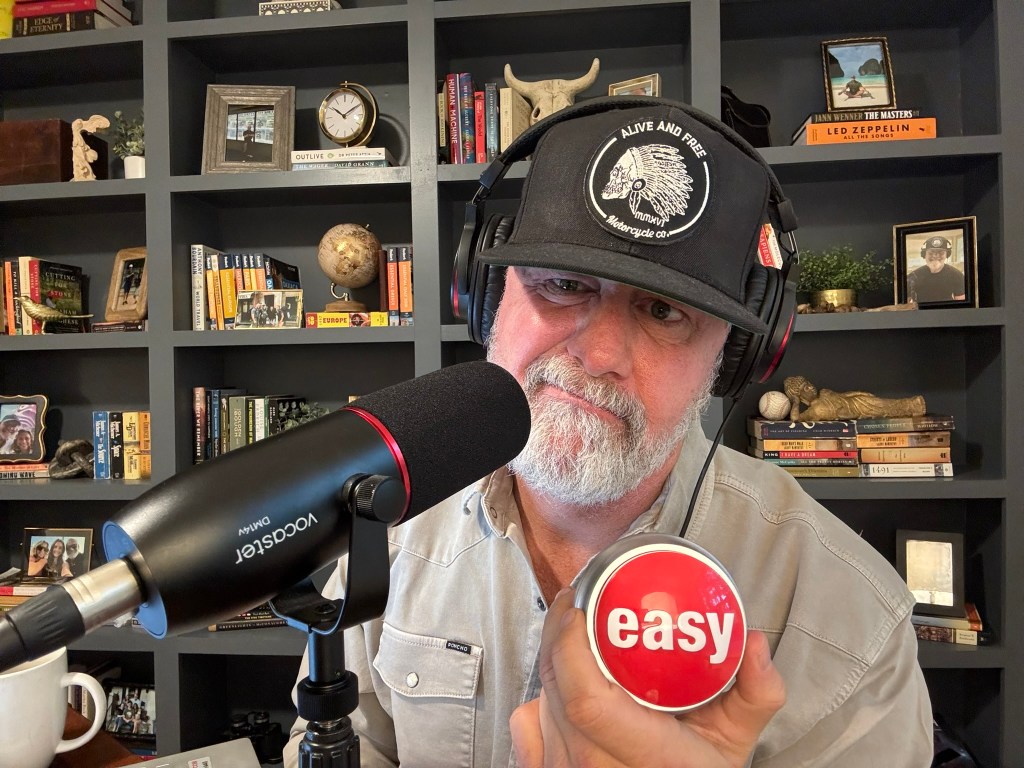

Recently, while rushing for my 12th cup of coffee in the company breakroom, a curious item on the table caught my attention. Someone had left one of those plastic, Easy Button promotional gadgets sitting there next to the Christmas cookies. It made me pause – and it got me thinking…
Somewhere between aisle nine and the copy paper, some genius marketing executive discovered what they thought could be humanity’s greatest hope for salvation: the Easy Button.
A bright red promise.
A shiny silver lining.
A plastic prayer to the gods of convenience.
I won’t lie. I desperately wanted one (especially on that given day). A real one. Preferably strapped to my forearm like a superhero gadget so I could press it during tax season, traffic jams, or whenever anyone says, “Hey Boss, we need to talk.”
Just imagine: an actual button that clears your inbox, reconciles your emotions, evaporates your worries, and perhaps—if you hold it down long enough—makes your relatives behave at Thanksgiving.
But here’s the plot twist: If life did have an Easy Button… would it still feel like life?
Would we still grow?
Would struggle still sculpt meaning?
Or would we all end up emotionally unseasoned—like my mother-in-law’s mashed potatoes?
Because the truth hiding inside that red, whimsical button is this:
Some of the most beautiful joys in our human journey are earned, not granted.
They come wrapped in grit, courage, confusion, the occasional meltdown, and the triumphant—sometimes wobbly—step forward afterward.
We were born to do hard things. In fact, hard things are often the very things that mold us into the best version of ourselves.
Introducing: The “Easier Button” We’ve Been Missing
Easy? No. But easier? Absolutely.
There is ancient wisdom that suggests life doesn’t get easier by avoiding difficulty. It gets easier by changing how we meet and react to difficulty.
And this is where Buddhism quietly sits down next to us, offers us a cup of warm tea, and says:
“You’re holding on too tightly.”
Which brings us to the Easier Button. Not a button you push to fix life… but a button you press to soften your grip on it.
Thich Nhat Hanh had a way of taking cosmic truths and wrapping them in modern, accessible language. He is often quoted as saying:
“Let go of the things that do not serve you. When you release them, you are free.”
and
“People have a hard time letting go of their suffering.
Out of a fear of the unknown, they prefer suffering that is familiar.”
He wasn’t promising painless living. He was promising freedom—the inner ease that comes when we stop clutching every moment like a phone we’re afraid to drop.
If Buddhism designed an Easy Button… It would probably be compostable.
Minimalist. Possibly made from recycled prayer flags or something like that.
And instead of chirping, “That was easy,” it might lean in gently and whisper:
“Let It Be.”
And maybe this is why we don’t really need an Easy Button after all. Maybe what we need is something more like what the Beatles offered decades before Staples sold their first red circle of hope.
In those timeless lines, “Speaking words of wisdom, let it be,” Paul McCartney sings not about resignation, but release. Not about giving up, but giving over.
To the moment. To the mystery. To the river of life.
That simple lyric echoes the same quiet truth whispered throughout Buddhist teaching:
There is a kind of power in loosening our grip.
A freedom in letting things be what they are.
A peace available when we stop wrestling with the world… and start listening to it.
Let It Be is one of my favorite songs of all time. Each time I listen, I’m reminded to find comfort not in answers, but in presence—that gentle reminder that even in “times of trouble,” there is a wiser voice within us saying, Don’t force it. Don’t clutch at it. Just breathe. Let it be.
Thich Nhat Hanh would nod knowingly at that chorus. He spent his life teaching that suffering begins not with pain itself, but with the war we wage against reality. He would tell us that to “let it be” is not passive—it is profoundly courageous. It says:
“I trust that this moment, even this one, has something to teach me.”
“I can meet life as it is, not as I demand it to be.”
“I can love deeply without clinging, and navigate difficulty without drowning in it.”
This is the Easier Button.
Not a device that makes life simple, but a posture that makes life livable.
Not a gadget that erases challenges, but an inner shift that lets us rise to meet them with an open heart and unclenched hands.
When we choose to let go of what we cannot control— the pace , the outcome or the impermanence of everything we love— we stop bracing against life and start dancing with it.
And suddenly, the world feels lighter. Not because the storm has passed,
but because we’ve stopped insisting that storms should not exist at all.
So maybe the button we’ve been searching for isn’t red or round or sold in office supply stores. Maybe it’s a breath. A moment of stillness. A willingness to release the story that everything must go our way before we can be at peace.
And when we finally learn to press that button— not to escape life, but to embrace it— we discover that every obstacle is a doorway, every hardship a teacher, every moment an invitation to return to ourselves.
Because if Buddhism knows anything, it’s this:
The real button isn’t magic at all. It’s mindfulness—the quiet, art of remembering that we don’t own the river, we don’t control its speed, and we definitely didn’t design its twists. We’re just learning to float along with a little more grace, a little less splashing, and far fewer attempts to boss the current around.
Mindfulness isn’t about deleting difficulties; it’s about meeting them with eyes wide open and breath steady. It’s the practice of pausing long enough to notice that life is happening now, not later— and that half our suffering comes from trying to out swim or out think something that was never chasing us in the first place.
And Buddhism—well, despite the exotic imagery Hollywood sometimes sells us—it isn’t about worshipping statues or memorizing ancient doctrines.
It’s far more intimate than that.
Buddhism is a kind of user manual for the human mind, written in metaphor, compassion, and the kind of simple truths that sound like poetry when spoken aloud.
It doesn’t demand belief; it offers tools.
- Tools for unclenching the heart.
- Tools for loosening the mind’s tight grip on certainty.
- Tools for remembering that peace isn’t something we chase—it’s something we create by how we relate to the moment in front of us.
At its core, Buddhism is a psychological toolkit cleverly disguised in verse and parable, a treasure box of human wisdom whispering:
“You don’t have to control everything to be okay.
You just have to stop trying to control everything.”
And once we start practicing that— once we learn to float rather than flail—
life doesn’t suddenly become easy. But it becomes easier in the only way that truly matters: from the inside out.
Just The Basics—No Funny Orange Robes Required:
If you have no insight into Buddhist teaching. Here’s a quick crash course to get you started.
1. Life Contains Pain (Surprise!)
Buddhism begins by observing that life has some unavoidable rough edges.
Stubbing your toe hurts. Loss hurts. Growth hurts (usually because it requires us to stop doing something that’s comfortable).
But the kicker is this: Pain is a natural and essential part of life. Suffering is the part we create.
Suffering is the story we build around the pain.
2. We Suffer Because We Cling
To expectations.
To outcomes.
To identities.
To “how things should’ve been by now.”
Buddhism calls this attachment and it’s the sticking point between what we want and what simply is.
3. Letting Go Makes Life Easier (Not Easy)
Letting go doesn’t make the storm disappear. It simply means we stop screaming at the clouds. It’s learning to care deeply without strapping ourselves to the mast of perfection. It’s trading control for presence.
Certainty for curiosity. Fear for flow.
4. Mindfulness Is the Button
Mindfulness is just practicing being here— not three catastrophes ahead,
not five regrets behind. It’s noticing your breath before your brain plays rerun loops of all seven seasons of your personal drama series.
5. You Don’t Control the River—But You Can Choose How You Float
Life moves.
It always has.
Fighting the current is exhausting.
Floating with awareness is liberating.
Even the Buddha himself didn’t promise a life without storms… only a life where the storms no longer own you.
What Exactly Are We Letting Go Of?
Oh, just the usual monsters under the bed:
- The illusion of total control
- The myth that perfect outcomes exist
- The belief that struggle is a sign of failure
- The fear that letting go means losing something essential
- The emotionally tangled ropes we cling to “just in case”
Letting go is the Easier Button. It’s the unburdening. The un-gripping.
The unclenching of the jaw, the chest, and the storyline.
Pressing the Easier Button in Everyday Life
Early on my journey of self discovery, I attended a mediation session at the local Tibetan Buddhist Center just down the street from my home (https://www.drepunggomangusa.org/). After the session, the monk facilitated a group Q&A session. One of the audience members approached the mic and asked the monk how he was to tackle a major issue he had been grappling with in his life. After listening intently, the monk lifted his head and calmly replied:
This problem of yours… Is there a solution? If the answer is NO, what are you so worried about? If the answer is YES, what are you so worried about?
This was my a-ha moment. My Road to Damascus awakening. A simple but profound way of helping me understand the true nature of just letting go.
Here are some simple, practical ways to bring all this down from the mountain and into your Monday morning:
1. Exhale on Purpose
A slow breath out is the oldest spiritual technology on Earth.
It resets the nervous system and tells your inner drama queen to take five.
2. Name What You Can’t Control
Say it out loud.
Write it down.
Let it go like a can of soup that expired in 2017.
3. Care Deeply—But Not Desperately
Love with open hands.
Relationships, work, dreams—they’re all living things.
They need space to breathe, not a chokehold.
4. Replace “Why me?” with “What is this teaching me?”
Every obstacle is a knock on the door of your personal development.
Some knocks are louder than others.
5. Trust the Mystery
Call it God, call it the universe, call it the cosmic traffic controller.
But let something larger than your ego take the wheel once in a while.
6. Embrace Impermanence
Everything changes.
Everything moves.
Everything evolves.
That means your current struggle is not permanent.
And neither is your current doubt.
Bringing It All Together: The Button We Really Need
The original Easy Button promised convenience. It suggested life could be conquered with a tap. But the button we actually need isn’t about removing the hard things. It’s about removing the extra things—the resistance, the rumination, the white-knuckle grip on outcomes that were never truly ours to command.
We grow not because the path is easy, but because we choose to walk it fully awake.
Letting go is not a denial of life; it’s a deeper trust in it. A belief that the river knows where it’s going… and that we are capable swimmers.
When we stop trying to bend the universe into our shape, we discover it already holds us— gently, curiously, sometimes clumsily, but always toward becoming more whole.
Maybe the real Easy Button isn’t a button at all. Maybe it’s a practice. A willingness. A subtle shift in posture.
And maybe—just maybe—when we stop fighting life and start dancing with it,
we find that everything we once labeled as an obstacle was actually a doorway into being fully, beautifully human.
 The Story of Us.
Leave a comment