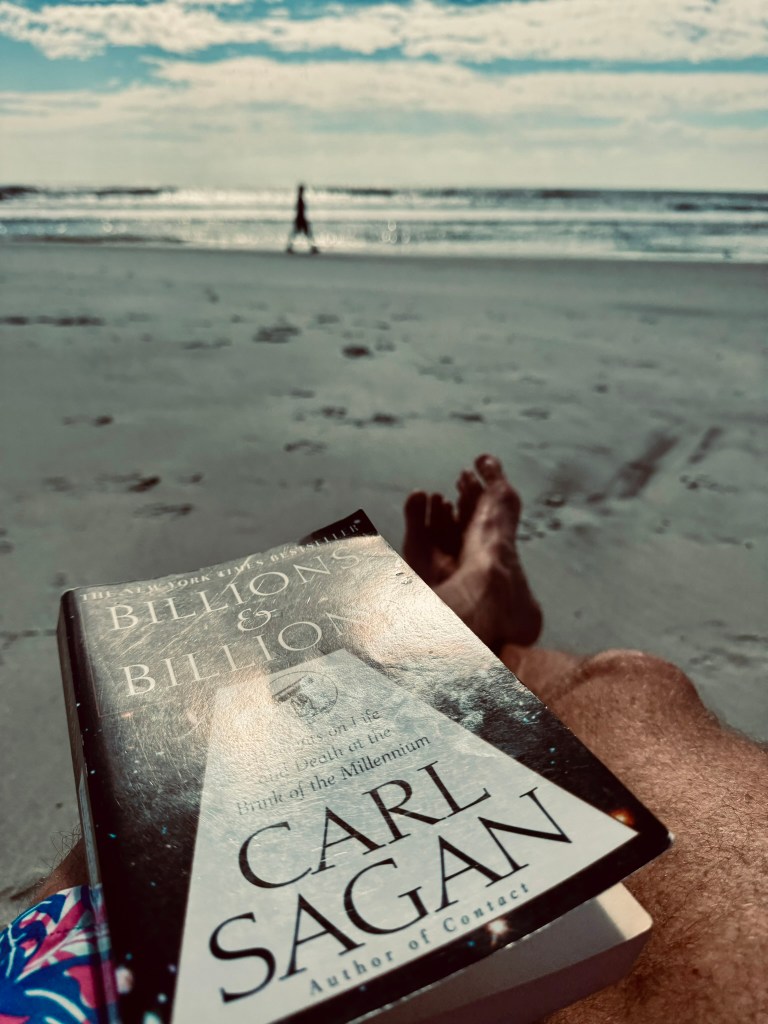
I read Billions and Billions on a brief vacation with my wife, Jessica, at one of our favorite beaches – Folly Beach in South Carolina. When you visit at the right time of year, it’s the kind of comfortable place that slows time. Slows it down just enough for me to find myself again.
We were on a little get-away, the ocean stretched out in front of us, waves arriving and dissolving like reminders of our impermanence. I remember sitting under an umbrella with sand in my toes and salt in the air, holding Carl Sagan’s final book and feeling the strange intimacy of reading a man’s last reflections while life unfolded all around me. It was quiet that October but still, a few children ran past. Gulls circled overhead. My wife read something she considers “entertainment” while sunbathing right beside me.
It was one of those near perfect days. And there I was, suspended between joy and gravity, sunlight, the ocean tides and my own mortality – digging into a book that found me precisely at the right moment.
In this final book of his astonishing career, Carl Sagan brilliantly examines the burning questions of humanity, the world we all share, and the universe around us. This collection of his essays covers both the vastness of the cosmos and the intimacy of the human mind, asking questions that feel both ancient and immediate:
- How did the universe originate?
- How will it end?
- What’s humanity’s place in this great immensity?
- And, how might we combine science and compassion to meet the challenges of the coming century?
What makes Billions and Billions especially powerful is that it’s not written from the lofty distance of an astrophysicist. Here we’re given a rare, private glimpse into Sagan’s inner world—his thoughts about love, death, and God—as he struggled with a fatal disease. Ever forward-looking, even as his time on Earth narrowed, Sagan remained insatiably curious. This book feels less like a goodbye and more like a final offering: honest, generous, and fully awake.
Reading it there, on that beach, I felt the contrast Sagan was grappling with—the tension between our longing for permanence and the undeniable truth of our transience. On one level, I was doing exactly what humans have always done when life feels good: sitting back, relaxing in a beach chair, letting the sun warm my skin, pretending—just for a few hours—that moments like this could last forever.
But the universe was not pausing for my vacation.




The waves kept arriving and disappearing. The sun had risen and the sun was slowly setting. Time moved forward with quiet indifference. And there, in the midst of all that motion, was Sagan’s reminder:
This is how everything works. Nothing stays. Nothing is exempt. And somehow, that is not a tragedy—it is the condition that makes love matter at all.
Love really did sit right beside me. My wife’s presence turned abstraction into reality. Mortality was no longer a distant philosophical problem; it was personal. The brief flame Sagan speaks of was right there between us—fragile but burning hotter with each passing day, luminous, and utterly real—asking not how long it would burn, but how brightly.
To learn to love the brief flame is not to resign ourselves to loss. It is to stop bargaining with time. It is to recognize that impermanence is not the enemy of meaning but its engine. The fact that this moment will end is precisely what makes it so special. The fact that life is finite is what gives it urgency, depth, and weight.
Sagan understood this. He did not ask us to deny our longing for more time—he shared it. But he challenged us to live as if this life, this tiny window of consciousness, is enough to deserve our full attention, our deepest care, and our most generous love.
The universe rolled on, as it always will. But for a little while, on a beach under a borrowed umbrella, two human beings held hands inside an extraordinary moment—and that, I think, is what it means to love the brief flame.
Billions and Billions Belongs so Naturally in The Story of Us.
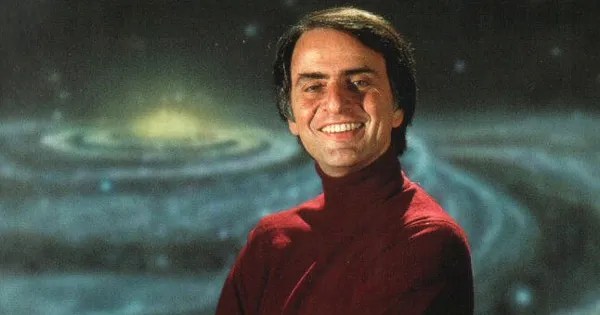
Carl Sagan had a rare gift. He could hold the secrets of the universe in one hand and the human heart in the other.
Billions and Billions is not just a smart people book about science. It’s a book about how to feel alive when the cosmos is vast, time is short, and certainty is in short supply. It’s about what it means to stand on a small planet, orbiting an ordinary star, and still insist that our lives can have real meaning.
One passage in particular feels like the emotional core of the book, and maybe of Sagan himself:
“I would love to believe that when I die I will live again, that some thinking, feeling, remembering part of me will continue… Far better, it seems to me, in our vulnerability, is to look Death in the eye and to be grateful every day for the brief but magnificent opportunity that life provides.”
This is not the voice of a skeptic. It’s the voice of a deeply feeling human who wants—desperately—to keep on truckin’. To grow old with his own wife. To watch his own children become. To witness the unfolding story of humanity and the cosmos. To forever have the privilege of turning the next page just to see what happens next.
Mortality as Motivation, Not Meaninglessness





One of the great myths about science is that it drains life of all meaning. Sagan shows the opposite can be true. For him, the possibility that death is final does not cheapen life—it intensifies it.
If this brief moment is all we get, then this moment matters enormously.
- Expressing our love becomes urgent.
- Curiosity about life becomes a responsibility
- That responsibility becomes unavoidable.
Sagan admits that belief in an afterlife is very convenient for us—it satisfies the human longing for meaning, soothes our grief, and promises us more time once we reach the finish line. But he insists that wanting something to be true doesn’t make it so. And instead of despairing at that realization, he does something radical: he chooses gratitude.
Not gratitude because the universe guarantees an answer to man’s desperate search for meaning—but gratitude because that meaning is something we get to make, together, for a little while, against impossible odds.
The Story of Us Is a Shared Story
Sagan never tells the human story as a solo act. Again and again, like Thomas Merton, he pulls us out of the illusion of separateness:
“Like it or not, we humans are bound up with our fellows, and with the other plants and animals all over the world. Our lives are intertwined.”
This insight sits at the heart of The Story of Us.
From cosmic dawn, when basic elements learned how to become stars, to the rise of Man, when those same elements learned how to walk, talk and feel, to our cultural foundation, when stories learned how to shape civilizations—nothing emerged in isolation.
Our breath is borrowed from plants.
Our food is borrowed from ecosystems.
Our ideas are borrowed from our ancestors.
And, our future is borrowed from generations we’ll never meet.
Seen this way, death is not just an ending—it’s a handoff.
The same atoms that once fueled ancient stars now animate your thoughts. One day, they will move on again. But, the story continues, even if our chapter closes.
Look clearly.
Love deeply.
Care fiercely.
And don’t waste the miracle pretending it’s something else.
A Brief but Magnificent Opportunity
Billions and Billions belongs in the Smart People Books series not because it makes the reader feel like a smarty pants but because it makes the reader feel awake.
Awake to time.
Awake to our interdependence.
Awake to the staggering improbability of even being here in the first place.
To learn to love the brief flame is not to resign ourselves to loss or slip into quiet despair. It is to stop bargaining with time, to stop asking life for guarantees it has never offered. A flame does not promise it will burn forever. It promises light. It promises warmth. It promises presence. And its very fragility is what draws us close enough to feel it.
Impermanence is not the enemy of meaning—it is the oxygen that allows meaning to burn at all. If life were endless, moments would lose their edge. Love would be postponed. Curiosity could wait until later. But because the flame is brief, everything sharpens. Presence becomes essential.
Sagan understood this with painful clarity. He wanted decades he knew he would not have, discoveries he would never see completed, futures that would unfold without him. And yet, rather than turning away from the flame because it would go out, he leaned closer. He asked what kind of light we might cast while it burned.
The challenge he leaves us is not simply to accept mortality, but to live in a way that honors it. To shield the flame from cruelty and indifference. To share its warmth rather than hoard it.
To recognize that our brief brightness is part of a much larger fire—one passed hand to hand across generations, cultures, and species.
The universe will outlast us. Stars will be born and die without noticing our names. But for this fleeting moment, consciousness has flickered into being—and it has learned how to love. That may be enough. Not because it lasts, but because it burns at all.
The universe has been telling its story for nearly 14 billion years.
For a fleeting moment, it has learned how to speak through us.
That isn’t nothing.
It’s everything.
And maybe—just maybe—that’s reason enough to be grateful today.
 The Story of Us.
Leave a comment